
The Hierophant
Overview
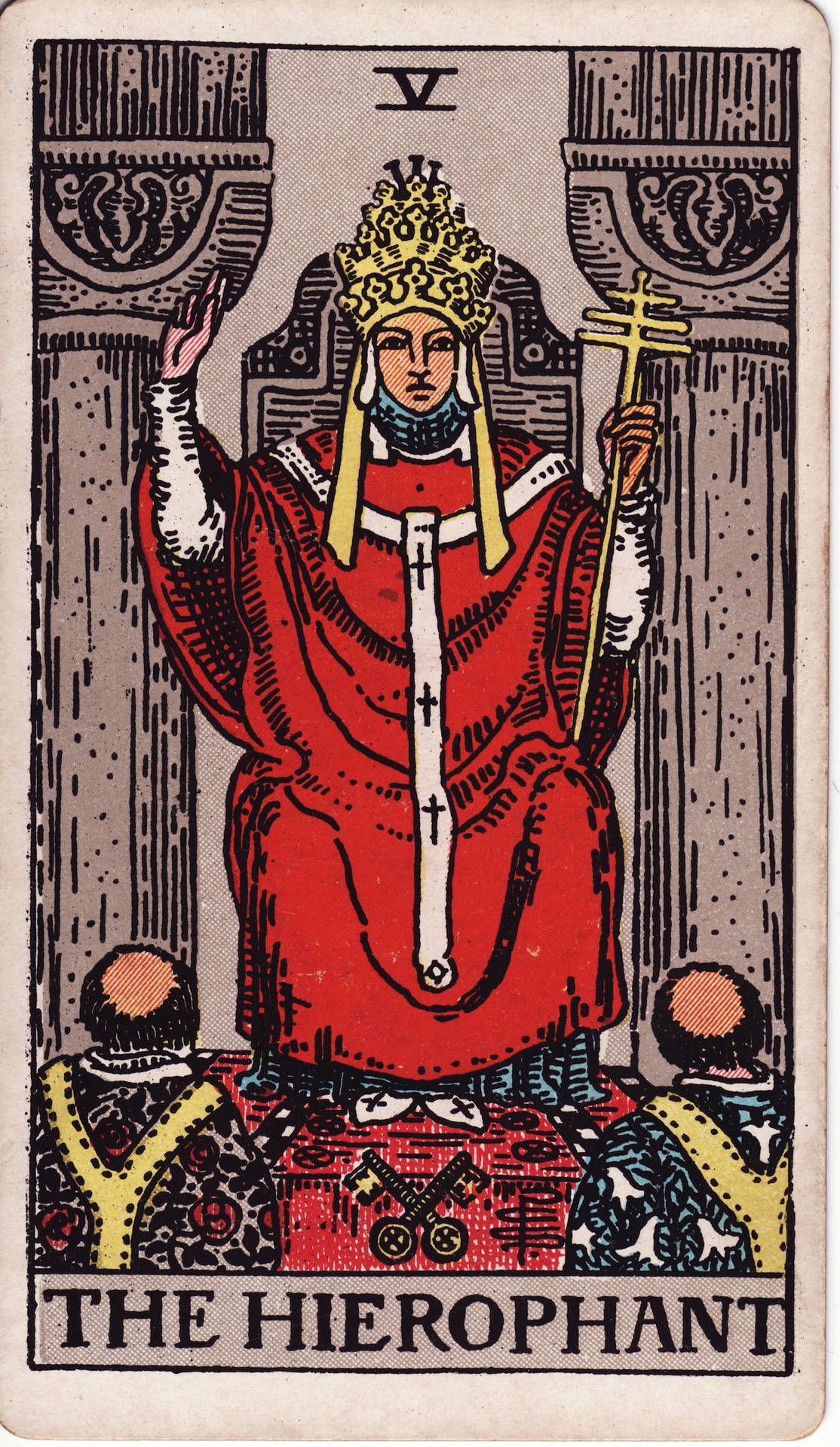
The Hierophant represents tradition, spiritual authority, and the pursuit of knowledge within structured belief systems. Often interpreted as a symbol of religious leadership, like the Pope, he embodies the external aspects of faith, guiding followers through established doctrines and rituals. Seated between two pillars, he signifies the balance between the known and the unknown, the esoteric and the exoteric. The crossed keys at his feet signify access to deeper truths, while his sceptre denotes his role as a mediator between the divine and humanity. This card encourages adherence to tradition and communal values, suggesting that wisdom often resides in the teachings of the past. However, it also warns against rigid dogma, reminding us to seek personal understanding within established frameworks.
Upright Meaning
Marriage, alliance, captivity, servitude; by another account, mercy and goodness; inspiration; the man to whom the Querent has recourse.
Two ministers kneel, keys lie crossed at his feet, and the triple crown is doing institutional work. This is the outer door: a tradition, a school, a marriage rite, a mentor with a real lineage, a practice that existed before your mood. You do not have to invent a private religion to take the next step. Ask the person who has actually kept the keys, and learn the form before you edit it. Alliance and servitude sit close together here. Joining a body, a studio, a faith, or a craft guild will ask for some of your freedom. Mercy and goodness belong in the teaching if it is healthy. Captivity is what you get when you outsource your conscience entirely.
Reversed Meaning
Society, good understanding, concord, overkindness, weakness.
Everyone is agreeing and nobody is holding the line. Overkindness has replaced the office: you bless every option, soften every standard, and call the resulting mush community. The keys are on the floor, useful to anyone who wants the title without the discipline. Concord is possible this week, and it will be weak if it depends on never naming a difference. Another trap is the crowd's blessing as a substitute for a teacher who can say no. If a group, a church, a method, or a family script is involved, ask what it costs to belong. Good understanding can be real. It still fails when it cannot bear a clear demand. Pick a practice and keep it when it is inconvenient.
Love Meaning
A bond wants a form other people could recognize: an exclusive agreement, a shared household rule, an introduction to the people who raised you, a ritual you repeat. Marriage is one old name for this card, and it also covers any alliance that asks for fidelity to a structure. That can be a relief if you have been floating. It becomes servitude if the script tells you who to be and you never look up from the manual. Talk about the actual vows, including the small ones about money, time, and other people. If you want the blessing of tradition, take the parts that make you kinder. Leave the parts that require you to disappear.
Career Meaning
A credential, a mentor, a house style, or a professional code is the shortcut you have been too proud to use. Learn it in the official order. The person you have recourse to is not the loudest peer. It is someone who has carried this work longer and will tell you the unfashionable rule. Institutions move slowly because they remember failures you have not met yet. Use that memory. If the hierarchy is rotten, you will feel the captive note quickly: speech policed, credit stolen, questions punished. In a sound one, apprenticeship is the speed. This week, ask for the canonical version, follow it once without improvising, and only then propose the change. Keys are earned by keeping faith with the door.
Feelings
You want sanction. The feeling underneath the question is not only love or ambition. It is the wish to be told by a respected voice that your path is legitimate. That longing can steady you, and it can make you small. Notice if you feel more loyal to a role, student, partner, believer, good child, than to the living fact in front of you. There may be comfort in ritual and irritation at anyone who skips the steps. There may also be a quiet rebellion you have not admitted. Both can be true. Feeling right is not the same as being held by a tradition that still deserves you. Test the relief you get from approval. See how long it lasts without an audience.
Yes or No
The Hierophant is a card of leadership and tradition. If you're looking for simple Yes or No guidance and receive The Hierophant, the answer is YES. Act in the best interests of your community and reputation.
Advice
Choose one established practice and keep its hours for seven days: the class, the service, the review ritual, the craft drill, the mentoring call. Ask a specific elder or expert one question you have been answering with opinions. Read the original instructions before the commentary. If you are the person others treat as the keys, be merciful and exact, not vaguely nice. Say what the standard is and what you will not pretend. If a group is asking for more of your conscience than you meant to give, write the boundary and deliver it without a speech about your journey. Belong on purpose. Do not drift into captivity because the crown was shiny and the kneeling looked like peace.
Symbolism
He wears the triple crown and is seated between two pillars, but they are not those of the Temple which is guarded by the High Priestess. In his left hand he holds a sceptre terminating in the triple cross, and with his right hand he gives the well-known ecclesiastical sign which is called that of esotericism, distinguishing between the manifest and concealed part of doctrine. It is noticeable in this connexion that the High Priestess makes no sign. At his feet are the crossed keys, and two priestly ministers in albs kneel before him. He has been usually called the Pope, which is a particular application of the more general office that he symbolizes. He is the ruling power of external religion, as the High Priestess is the prevailing genius of the esoteric, withdrawn power. The proper meanings of this card have suffered woeful admixture from nearly all hands. Grand Orient says truly that the Hierophant is the power of the keys, exoteric orthodox doctrine, and the outer side of the life which leads to the doctrine; but he is certainly not the prince of occult doctrine, as another commentator has suggested. He is rather the summa totius theologiæ, when it has passed into the utmost rigidity of expression; but he symbolizes also all things that are righteous and sacred on the manifest side. As such, he is the channel of grace belonging to the world of institution as distinct from that of Nature, and he is the leader of salvation for the human race at large. He is the order and the head of the recognized hierarchy, which is the reflection of another and greater hierarchic order; but it may so happen that the pontiff forgets the significance of this his symbolic state and acts as if he contained within his proper measures all that his sign signifies or his symbol seeks to shew forth. He is not, as it has been thought, philosophy-except on the theological side; he is not inspiration; and he is not religion, although he is a mode of its expression.
Pictorial reference: Wikipedia